Community Journalism

The stories our neighborhood
deserves to tell

Community-powered reporting on local sustainability and resilience — filling the gap left by a generation of local news collapse.

The Sustainability Journalism / Citizen Journalism companion to the S.E.E.D. program is a community news platform that celebrates the diversity, rich social fabric, and shared economic success of Queens, New York City.

This platform — like all of our programs — is entirely community-supported.

Make a Donation →
Latest Story
Economic Analysis

Who’s Setting the Price Tag? How Inflation Shifted from Worker Wages to Big Business Markups

Comparing the 1979–1982 wage-price spiral to the post-2021 corporate markup surge — and why the Federal Reserve keeps reaching for the same tool no matter which one is driving prices
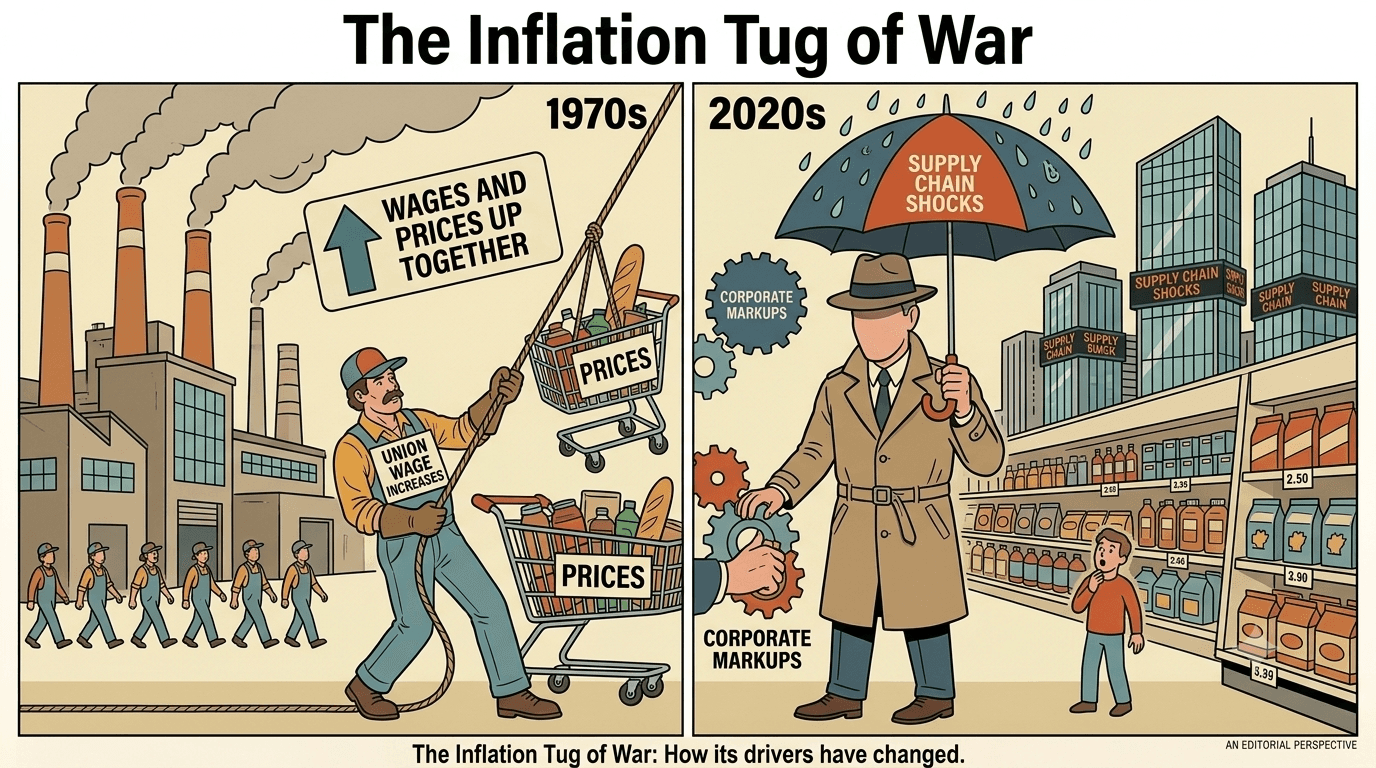
Illustration titled The Inflation Tug of War: on the left, a 1970s factory worker in a line of workers hauls a shopping cart labeled prices via a pulley system marked union wage increases, beneath a sign reading wages and prices up together and smoking factory towers; on the right, a 2020s corporate figure in a trench coat and hat shelters under an umbrella labeled supply chain shocks while turning gears labeled corporate markups, overlooking a grocery aisle with rising price tags and a child looking at the shelves; captioned The Inflation Tug of War: how its drivers have changed
Same shock, different squeeze: in the 1970s, workers pulled for higher wages to keep up with prices. In the 2020s, dominant corporations used supply-chain shocks as cover to expand profit margins instead.

To understand how inflation really works, it helps to look at it not as a mystery of numbers, but as a tug-of-war over who pays the bill when economic shocks hit.

By comparing two distinct eras — the inflation crisis of 1979–1982 and the post-2021 inflation wave — we can see how the drivers of inflation have completely flipped. In the late 1970s, price increases were driven by workers demanding higher wages to keep up with rising costs. Post-2021, price hikes were driven by large corporations using supply disruptions as cover to expand their profit margins.

Era 1: The 1979–1982 Volcker Shock

When rising wages fueled the inflation spiral.

The background. In the late 1970s, double-digit inflation was triggered by global oil crises and slowing economic growth. At the time, organized labor held significant power. Millions of everyday workers belonged to unions, and many labor contracts included automatic cost-of-living adjustments (COLAs) that raised wages whenever prices went up.

When energy and food costs spiked, workers had the leverage to demand higher pay to protect their families’ purchasing power. Businesses then raised their prices to protect their profit margins, which led workers to ask for even higher pay. This created a classic “wage-price spiral.”

The policy response. In October 1979, Federal Reserve Chairman Paul Volcker took drastic action. The Fed raised interest rates past 20%, intentionally slowing the economy down to break the inflation cycle.

The result.The “Volcker Shock” effectively ended the wage-price spiral by putting millions of people out of work:

  • Loss of worker leverage. As unemployment hit 10.8% in 1982, workers lost the power to demand higher pay. Real wages fell.
  • A shift in power. Combined with major anti-union policy moves during the 1980s, the balance of power permanently shifted away from workers and toward corporate employers.
  • Long-term impact. From 1980 onward, the share of economic output going to worker pay steadily declined, while corporate profits and financial returns surged.

Era 2: Post-2021 “Sellers’ Inflation”

When big business markups drove price spikes.

The background. The inflation that followed the COVID-19 pandemic and the 2022 invasion of Ukraine looked fundamentally different. Decades of union decline meant workers did not have the bargaining power to cause a wage-price spiral; in fact, worker pay actually fell behind rising shelf prices.

Instead, landmark research by economists Isabella Weber and Evan Wasner showed that post-2021 inflation was driven primarily by “sellers’ inflation” — large corporations using cost disruptions to pad their profit margins.

How sellers’ inflation works, in three steps:

  1. The cost shock. A major bottleneck occurs (such as microchip shortages, shipping logjams, or energy spikes) that hits an entire industry at once.
  2. Implicit price coordination. Because a few dominant corporations control most major industries (like meatpacking, grocery retail, or shipping), the cost shock acts as a green light. Every major company knows its competitors are facing the same costs, so they can all raise prices at the same time without worrying about losing customers to a cheaper rival.
  3. Price over volume. Rather than just passing along the exact extra cost of raw materials, large corporations realized they could hike prices even higher because consumers already expected inflation. Businesses shifted to a strategy of selling slightly fewer goods, but at significantly higher profit margins.

Data from the Federal Reserve Bank of Kansas City and the U.S. Bureau of Economic Analysis confirmed that corporate profit expansion accounted for over 50% of the initial surge in U.S. inflation in 2021 — far outpacing the impact of wage increases.

The policy mismatch. Despite the evidence that corporate markups were driving prices up, the Federal Reserve used the exact same playbook from the 1970s: rapid interest rate hikes aimed at cooling down the job market. This exposes a fundamental flaw in traditional inflation control:

  • The wrong tool.Raising interest rates doesn’t unblock supply chains, produce more goods, or force a monopoly to lower its profit margin.
  • Unfair burden. By relying only on interest rate hikes, the government attempts to fix a profit-driven problem by slowing down hiring and raising borrowing costs for everyday families and small businesses, while big corporations keep their record markups.

Side by Side: 1979 vs. Post-2021

DimensionThe 1979–1982 Volcker eraThe post-2021 era
Main engine of inflationWage-price spiral — workers demanding higher pay to keep upProfit-margin expansion — big business marking up prices above cost
Worker leverageStrong (high union density, automatic cost-of-living raises)Weak (low union density, wages falling behind shelf prices)
Who benefited during the shock?Workers attempted to protect their pay; corporate profits were squeezedCorporations successfully expanded margins; big business hit record profits
Government strategy usedMassive interest rate hikes to slow hiring and reduce worker powerStandard interest rate hikes, despite profits driving the price hikes
Unused alternative solutionsJoint government-business-labor wage and price agreementsTargeted windfall profit taxes, price-gouging oversight, antitrust enforcement
The bottom line: Comparing 1979 to the post-2021 era shows that how we handle inflation is ultimately a political choice. When price spikes hit, the state chooses whether to cool inflation by squeezing worker pay and slowing down small businesses through high interest rates, or by placing limits on big business profit margins and market power.
Our First Published Story
Community Notebook

Lanterns, Loukoumades and a Saint from Cappadocia: St. Irene’s Panegyri Fills 23rd Avenue Again

Astoria’s oldest continuously running Greek festival draws the faithful — and half the neighborhood — through Tuesday

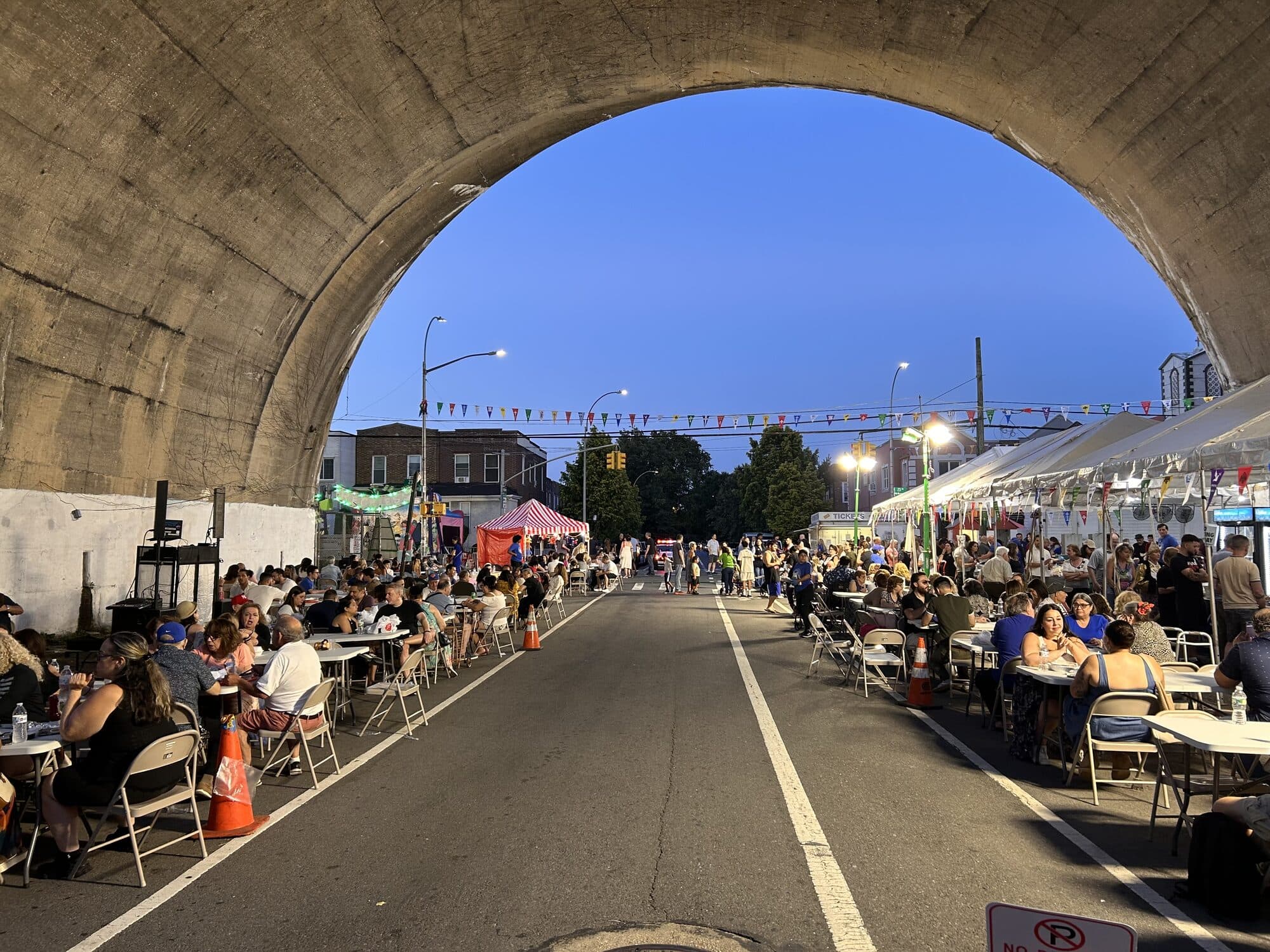
Festivalgoers fill long tables beneath the railroad viaduct on 23rd Avenue at dusk during the St. Irene Chrysovalantou panegyri
Dinner under the arch: festivalgoers fill long tables beneath the railroad viaduct as the last light goes out of the sky over 23rd Avenue.

ASTORIA, QUEENS — If you found 23rd Avenue closed to traffic on Sunday evening and a hundred folding chairs sitting where the cars usually go, congratulations: you had stumbled into the annual panegyri of St. Irene Chrysovalantou, and you were about ten steps from a plate of loukoumades.

The four-plus-day festival, running July 24 through Tuesday, July 28, unfolds in the street outside the Sacred Patriarchal and Stavropegial Orthodox Monastery of St. Irene Chrysovalantou at 36-07 23rd Avenue, spilling down 36th Street and settling in under the great concrete arch of the railroad viaduct, where families ate at long white tables in the blue half-hour after sunset.

Who Was St. Irene?

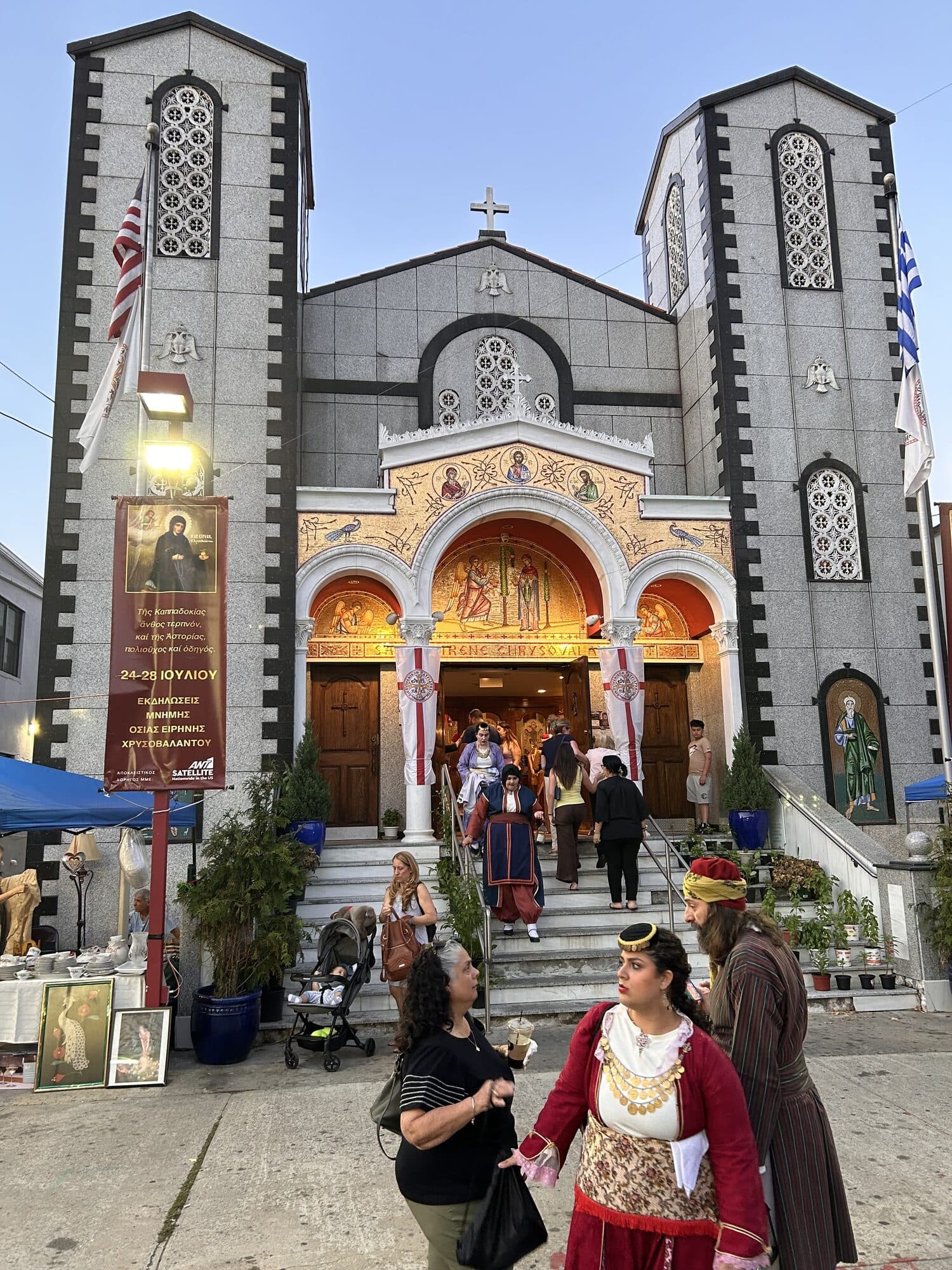
The saint on the banner by the front steps — the one holding the apples — was a ninth-century Byzantine noblewoman from Cappadocia, in what is now central Turkey. Tradition holds that Irene was summoned to Constantinople to be considered as a bride for the young emperor, met the holy man Joannicius on the road, and arrived at the capital to find the emperor already married. She entered the convent of Chrysovalantou instead, eventually became its abbess, and lived, by the accounts, to 102. An angel is said to have brought her three apples from paradise — hence the fruit in her hand on every icon. Her feast day is July 28.

The monastery here in Astoria was founded in 1972 by Paisios of Tyana and has kept the festival going every summer since. The banner outside puts the neighborhood’s claim on her plainly, in the old hymn style: delightful flower of Cappadocia — and of Astoria, patron and guide.

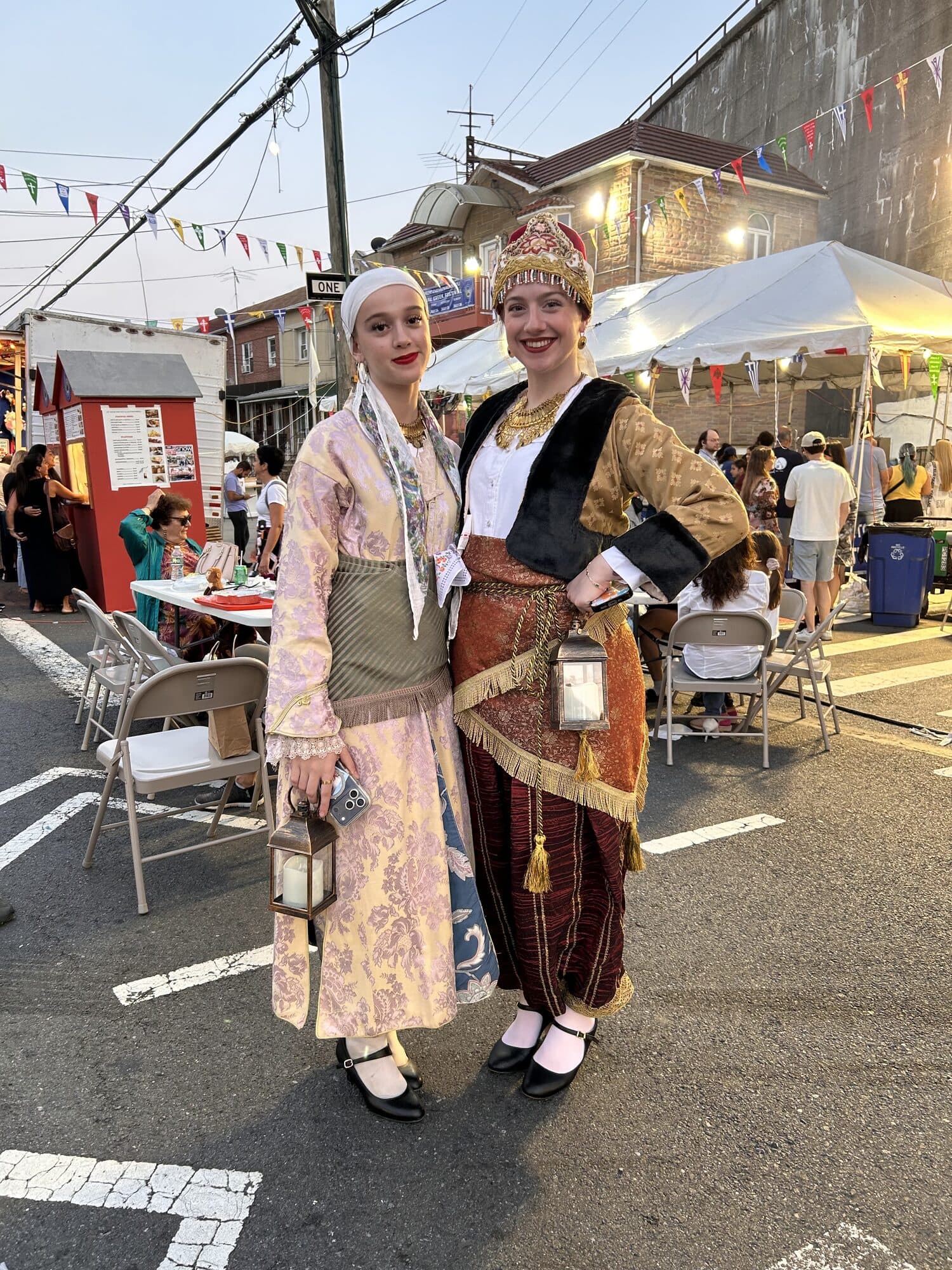
Two members of the folk dance troupe in embroidered regional costume, carrying lanterns
Two members of the folk dance troupe, in embroidered regional costume and carrying lanterns, pause between performances near the food tents.
Worshippers on the front steps of St. Irene Chrysovalantou beneath the festival banner and American and Greek flags
Worshippers file down the front steps on Sunday evening, past the festival banner marking July 24–28. American and Greek flags fly from the twin bell towers.

The Important Part: The Food

Souvlaki and kontosouvli off the grills, plus the full lineup of pans — moussaka, pastitsio, gemista — and, on the sweets table, galaktoboureko, portokalopita, and the honey-drenched loukoumades that people have been known to queue for twice. A menu board on the red booth listed portions and platters for the undecided.

For the younger set there were rides and games, an inflatable, and a flea market worth a slow lap: stacked china, brass lamps, framed peacock pictures. Inside the vestibule, a religious goods table offered icons and books. Come nine o’clock, the dance floor belonged to the costumed troupes — young women in embroidered regional dress, gold coin necklaces, velvet vrakes, a lantern in each hand — and the crowd three rows deep around them.

And Another Thing

Look up at the pennants strung across the avenue and you notice something: they are not all Greek flags. Not remotely. Which is about right for this corner of the world. Northwestern Queens — Astoria, Ditmars-Steinway, Long Island City, Sunnyside, Woodside, Jackson Heights — is one of the most linguistically diverse patches of ground on the planet, a place where a Greek monastery, an Egyptian bakery, a Bangladeshi grocery, a Colombian bakery and an Italian social club can share a single bus route without anyone finding it remarkable. The block party for a Byzantine abbess is not an exception to that neighborhood. It is a pretty good example of it.

If you go:Festivities continue nightly through Tuesday, July 28, when the feast day itself brings services and the traditional procession of the saint’s icon through the streets. Check with the monastery for exact times.
Why This Matters

The local news gap

Over the past two decades, thousands of local newspapers across the United States have shut down or drastically reduced their coverage — leaving communities without the reporters who once covered city hall, neighborhood development, environmental hazards, and the small stories of local resilience that never make national headlines.

🏗️

Small businesses making meaningful environmental changes with no platform to share them

🌿

Neighborhoods organizing around air quality, water access, and green space — without public documentation

🤝

Community gardens, energy co-ops, and mutual aid networks that never reach the audiences who need them

🔍

Corporate sustainability claims that go unverified because no local reporter is present

How It Works

Built into every SEED engagement

This program is a direct derivative of the S.E.E.D. program and its Community Impact Partnership (CIP) mechanism. The student consultant who conducts the sustainability audit also writes the story. The two functions are unified by design.

01
CIP Engagement

Student consultant embeds with a partner business in a S.E.E.D. Zone

02
Sustainability Audit

Operations analyzed, data gathered, claims verified against direct observation

03
Published Story

Every CIP engagement produces a verified feature story on the platform

Editorial Standards

What makes a story

Hyper-Local

Rooted in specific neighborhoods, blocks, and communities — not abstract policy or national trends.

Solution-Oriented

Centered on what communities are building, not only what's broken.

Human-Centered

Told through the people living, working, and organizing — owner motivation, staff experience, community response.

Verified

Sustainability claims checked against audit data, interviews, and direct observation. Not PR. Not a blog.

Coverage Areas

What we cover

Stories that illuminate community sustainability at the neighborhood level — the work that institutional media consistently overlooks.

  • Local businesses transforming their operations and their neighborhood role
  • Community organizations building environmental resilience
  • Neighborhood-level responses to heat, flooding, air quality, and water access
  • Green business districts and S.E.E.D. Zone developments
  • Local sustainability innovators and community change-makers
  • Holding corporate actors accountable to community-level commitments

The Impending Bloom
Citizen Journalism Platform

Published stories appear directly on this platform and flow through university chapter social channels, partner business networks, and S.E.E.D. Zone community networks — reaching the audiences who need them most.

More stories coming soon — every CIP engagement produces a published feature.

Have a story in your community?

We are always looking for community members, student reporters, and organizations with stories that deserve to be told.

Learn About S.E.E.D.

Want to support independent community journalism? A contribution of any size helps fund the reporters, editors, and infrastructure that make this work possible.

Support the mission →